


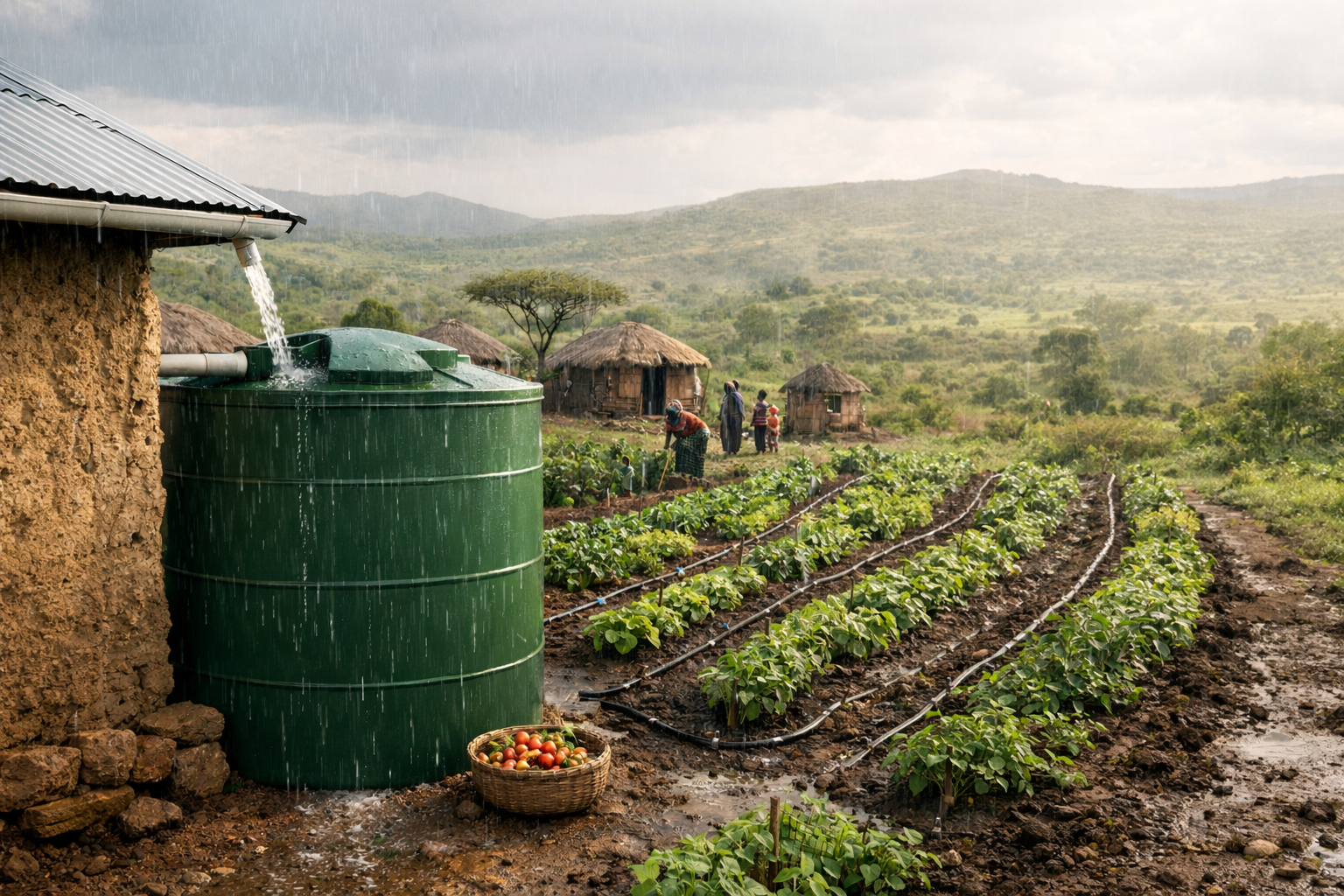
Sustainable Water Management and Rainwater Harvesting in Somalia

Securing the Future
Water is the lifeblood of every ecosystem, yet for Somalia, it remains one of the most volatile resources. Climate change has led to erratic rainfall patterns, resulting in a devastating cycle of droughts and flash floods. At Waara Green Organization, our strategic focus is to shift from “water crisis management” to “Water Sovereignty” through sustainable harvesting and innovative conservation techniques.
1. The Science of Rainwater Harvesting (RWH)
Rainwater harvesting is the simple yet effective process of collecting and storing storm-water for later use. Instead of allowing runoff to cause soil erosion, we can capture it through:
- Roof Catchment Systems: Utilizing residential and public building roofs to channel water into storage tanks.
- Earth Dams and Berkads: Rehabilitating traditional Berkads with modern engineering to reduce evaporation and contamination.
- Sand Dams: Building low-cost barriers across seasonal rivers (Wadis) to trap water and sand, creating a natural filtered underground reservoir.
2. Combatting Salinity and Groundwater Depletion
Over-reliance on deep wells has led to the depletion of our aquifers and an increase in water salinity (biyo dhanaan).
- Artificial Recharge: By slowing down rainwater, we allow it to seep back into the ground, naturally “refilling” our underground water sources.
- Water Quality Protection: Waara Green Organization works on protecting natural springs from pollution, ensuring that the water remains safe for both humans and
3. Integrated Irrigation for “Green Belts”
Water management is directly linked to our reforestation efforts (Topic 1). Using Drip Irrigation—a method of delivering water directly to the root of the plant—we can grow thousands of trees using 70% less water than traditional methods. This efficiency is a core part of our strategic plan to create “Green Belts” around Somali cities.
4. Community-Led Water Governance
Our strategic plan emphasizes that water management must be local. By forming Water User Committees, we empower communities to:
- Monitor water
- Maintain harvesting
- Ensure equitable distribution during the dry season (Jilaal).
Fact Sheet: Strategic Water Harvesting Technologies for Somalia
Understanding the best method for water collection depends on the landscape and the intended use. Below is a comparison of the most effective technologies:
| Technology (Habka) | Primary Use (Isticmaalka) | Water Source (Isha Biyaha) | Storage Capacity | Durability & Cost |
| Rooftop Harvesting | Household/Drinking | Rain from roofs | Low to Medium (Tanks) | Low cost; easy to maintain. |
| Enhanced Berkad | Livestock & Irrigation | Surface runoff | Medium (100–
500 $m^3$) |
Moderate cost; needs lining to prevent leaks. |
|
Sand Dams |
Community/Large Scale | Seasonal rivers (Wadis) | High (Sub- surface storage) | High cost; lasts for 50+ years; zero evaporation. |
| Check Dams | Soil moisture/Small scale | Slopes and gullies | Recharges groundwater | Low cost; essential for reforestation. |
| Earth Pans (War) | Large Scale Livestock | Surface runoff | Very High (1,000+ $m^3$) | Low cost; high evaporation rates. |
Strategic Advantage: Why Sand Dams?
For the Waara Green Organization strategic plan, we prioritize Sand Dams in mountainous or dry riverbed areas.
- Evaporation-Free: Since the water is stored beneath the sand, the scorching Somali sun cannot evaporate it.
- Natural Filtration: As water soaks through the sand, it is naturally filtered, making it cleaner for use.
- Groundwater Boost: It raises the water table in the surrounding area, allowing trees to grow even during the Jilaal (dry season).
Conclusion
Water scarcity is not an inevitable fate; it is a management challenge. Through scientific harvesting and community action, Waara Green Organization is building a future where every drop of rain is a seed for prosperity. By securing our water, we secure our food, our health, and our land.